

Most people know what a supplement does. Far fewer understand what it takes to make one that is safe, accurate, and legally compliant. The dietary supplement manufacturing process involves formulation science, raw material testing, GMP production, quality control, stability validation, and regulatory review. Every one of these stages carries requirements that directly affect whether the finished product performs as labeled.
The powdered supplement manufacturing process alone involves weighing, blending, bulk density testing, and humidity control before a single capsule is filled. That level of detail runs through every stage. This article covers each of the ten stages in sequence, including the ones most new brands do not encounter until something goes wrong.
Advanced Supplements is a GMP-certified, FDA-registered US contract manufacturer. We handle custom formulation, encapsulation, testing, and private label. Request a quote to start your project.
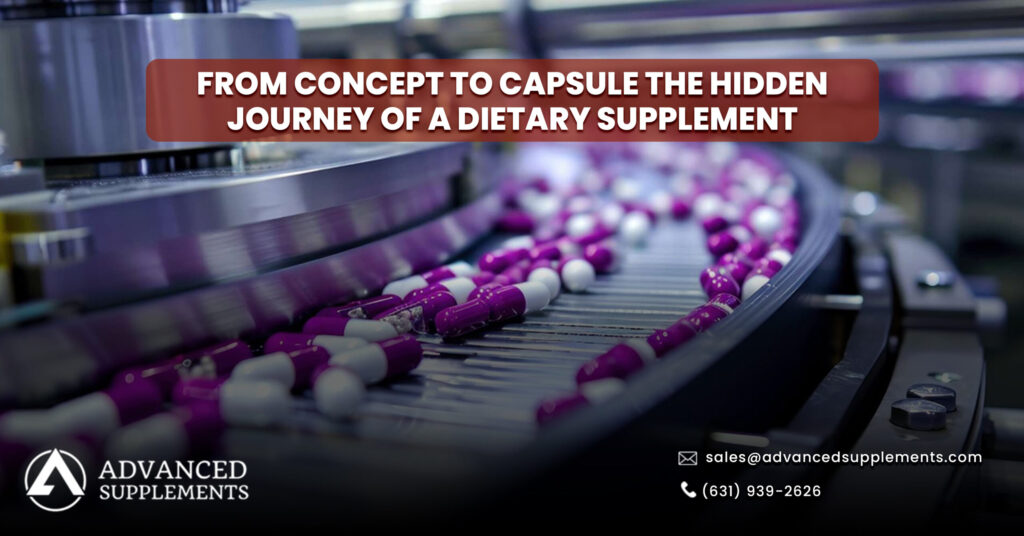
From concept to capsule, dietary supplement manufacturing requires GMP production, raw material testing, formulation science, stability validation, and FDA-compliant labelling to ensure every supplement is safe, accurate, effective, and legally compliant.
Stage 1: Product Concept and Market Positioning
Supplement development starts with a business question, not an ingredient. Who is the target consumer, what problem does the product solve, and how crowded is the market? Brands that skip this step and jump to formulation often discover mid-development that the product is not differentiated or the price point is not viable.
A focused concept defines the intended health benefit, the target customer, and the delivery format before any formulation begins. A sleep supplement for adults over 40 has completely different ingredients and dosing requirements than a recovery supplement for competitive athletes. Getting this right upfront prevents expensive reformulations downstream.
Stage 2: Custom Supplement Formulation
Formulation is where the product concept becomes a specification. A qualified formulator reviews the clinical research for each proposed ingredient, evaluates dosing evidence, assesses ingredient interactions, and selects excipients compatible with the chosen delivery form. The output is a formula document listing every ingredient by name, form, and exact concentration per serving.
Brands have two paths. Stock formulas use pre-validated ingredient combinations a contract manufacturer already produces, which reduces time and cost. Custom supplement manufacturing develops a proprietary formula the brand owns, which competitors cannot replicate. The right choice depends on timeline, budget, and how differentiated the product needs to be.
Excipients are a detail brands frequently overlook. Flow agents like silicon dioxide prevent powder bridging in capsule-filling machines. Magnesium stearate lubricates capsule production runs. Microcrystalline cellulose adjusts fill weight when the active dose is too small for the selected capsule size. The wrong excipient for a hygroscopic active can cause physical instability long before the product reaches the shelf.
Stage 3: Selecting the Right Dosage Form
The decision between capsules, tablets, softgels, and powders is not just a consumer preference question. Each format has fill weight constraints, ingredient compatibility requirements, and cost structures that should drive the decision alongside market positioning.
Hard shell capsules are the most versatile format for powder and granule fills, require the least compression force, and are the lowest cost format outside bulk powder. Tablets can deliver higher doses in a smaller physical form but degrade fragile botanical extracts under compression.
Softgels are required for oil-based ingredients like omega-3 fatty acids and fat-soluble vitamins that cannot be encapsulated in powder form. Powders offer the highest dose flexibility but raise palatability and mixability requirements that directly affect consumer repeat purchase rates.
Stage 4: Raw Material Sourcing and Incoming Quality Testing
A supplement is only as clean as the ingredients it contains. Every raw material shipment entering a GMP-compliant facility requires incoming quality testing before release to production. Under 21 CFR Part 111, manufacturers must establish ingredient specifications and test incoming materials against them. Materials that fail are quarantined. This is a regulatory requirement, not a best practice.
Testing covers identity confirmation through HPLC or FTIR spectroscopy, potency verification, microbiological contamination limits including E. coli and Salmonella, and heavy metals analysis for lead, arsenic, cadmium, and mercury. All results are documented on a Certificate of Analysis, which becomes part of the permanent batch record for every production run using that material. Brands working with a contract manufacturer should ask to see raw material COAs before placing a production order.
Stage 5: GMP Manufacturing and the Production Floor
Manufacturing takes place in a GMP-certified facility operating under current Good Manufacturing Practices as defined in 21 CFR Part 111. The GMP framework covers facility design, equipment qualification, employee training, sanitation, environmental monitoring, and the documentation requirements that link each production batch to specific materials, operators, and test results.
Production begins with a batch record specifying what will be produced, in what quantity, using which ingredient lots. Weighing is the first critical step. Each ingredient is measured on a calibrated scale and independently verified by a second operator before blending begins. This dual-verification requirement exists because weighing errors are the most common source of potency deviation in finished supplements.
Blending time, speed, and blender load are validated parameters. Under-mixing produces non-uniform product where some capsules contain too much active ingredient and others too little. Encapsulation follows, using automated filling equipment calibrated to deliver fill weights within a validated tolerance. In-process weight checks run at defined intervals throughout the production run.
Knowing how to choose a capsule supplement manufacturing company starts with confirming they maintain documented GMP procedures for each of these steps, not just a certification on the wall.
Stage 6: In-Process Quality Control and Batch Documentation
Quality control in supplement manufacturing runs continuously through production, not at the end. In-process checks cover fill weight, capsule appearance, disintegration time for tablets and coated formats, and seal integrity for softgels. Any deviation triggers a hold and documented investigation before the run continues.
Batch records are the legal record of how each lot was produced. They document which materials were used, who performed each step, which equipment ran, and what the in-process results were. A GMP facility must be able to produce a complete batch record for any product it has manufactured. The NIH Office of Dietary Supplements has noted that finished product quality in the supplement industry varies significantly, and batch documentation is the primary control that prevents substandard product from reaching consumers.
Stage 7: Finished Product Testing
Before any batch ships, it must pass a full panel of finished product tests confirming that what is in the bottle matches the label. Testing covers active ingredient potency, identity confirmation, microbiological safety, heavy metals, and moisture content. Results must meet the specifications in the product’s master manufacturing record.
Third-party testing adds an independent verification layer outside the manufacturer’s own lab. USP runs third-party certification programs that verify finished products contain labeled amounts and are free from harmful contaminants.
Certificates of Analysis from finished product testing accompany each batch shipment and should be retained by the brand for regulatory and retail compliance purposes.
Stage 8: Stability Testing and Shelf Life
Stability testing determines how long a supplement retains its potency, appearance, and microbiological safety under real storage conditions. A product that degrades to 70 percent of labeled potency at month six of a 24-month shelf life claim is both ineffective for the consumer and non-compliant with labeling requirements.
Real-time stability testing stores samples under controlled conditions and tests them at regular intervals across the full shelf life. Accelerated stability testing uses elevated temperature and humidity to predict long-term behavior faster. Stability data also determines packaging requirements. Finding a reliable supplement manufacturer means confirming they conduct stability studies appropriate to your product’s ingredients and format, not just accepting a generic shelf life claim.
Stage 9: Label Compliance and the Supplement Facts Panel
A dietary supplement label sold in the United States must include a Supplement Facts panel listing each active ingredient by name, form, and amount per serving, a statement of identity, directions for use, any required warnings, and manufacturer contact information. Under DSHEA, structure-function claims such as “supports healthy sleep” are permitted with a required FDA disclaimer: this statement has not been evaluated by the Food and Drug Administration and the product is not intended to diagnose, treat, cure, or prevent any disease.
Disease claims that imply the product can treat or prevent a medical condition are prohibited without FDA drug approval, which dietary supplements do not hold. Label review against product specifications is a required step before printing. An error found post-packaging delays launch and creates waste that brands consistently underestimate at the planning stage.
Stage 10: Private Label and Contract Manufacturing
Most supplement brands work with a contract manufacturer rather than building their own facility. Private label supplements use a manufacturer’s existing, pre-validated formulas under the brand’s label, which is the fastest and lowest-cost path to market. Custom contract manufacturing develops a proprietary formula the brand owns, which the manufacturer cannot sell to other clients. Most contract manufacturers offer both options, and some brands run a private label product while a custom formula is developed in parallel.
The contract manufacturer relationship covers more than production. A qualified partner handles incoming material testing, GMP documentation, finished product testing, certificate of analysis issuance, and the regulatory records a brand needs when a retailer, platform, or regulatory body requests documentation.
Working With a GMP-Certified Supplement Manufacturer
The journey from concept to capsule involves more moving parts than most brands anticipate when they start. Formulation science, raw material integrity, manufacturing precision, documentation discipline, and regulatory accuracy all have to work together to produce a supplement that is safe, effective, and legally compliant.
Choosing a contract manufacturer with documented GMP certification, verified testing practices, and experience in your specific product category reduces the risk at every stage of the process. The right manufacturing partner does not just fill capsules. They identify formulation compatibility issues before production, document everything required for regulatory review, and test finished product against specifications before it ships.
Advanced Supplements is a GMP-certified, FDA-registered dietary supplement manufacturer based in the United States. We handle custom formulation development, ingredient sourcing and testing, encapsulation, tableting, powder manufacturing, finished product testing, and private label services. Find a reliable supplement manufacturer by reviewing our documentation practices, asking to see a sample batch record, and confirming third-party audit availability before committing to a production partner.
Frequently Asked Questions
How long does it take to manufacture a dietary supplement?
Custom formulas take 3 to 6 months to finish. Private label formulas using existing specs typically ship in 6 to 10 weeks.
What is a Certificate of Analysis in supplement manufacturing?
A Certificate of Analysis documents identity, potency, and microbiological test results for each ingredient and finished production batch.
What does GMP certification mean for supplements?
GMP certification means the facility meets FDA standards for supplement quality, safety, and documentation required under 21 CFR Part 111.
What is the difference between private label and custom supplements?
Private label uses a pre-existing formula under your brand name. Custom manufacturing develops a proprietary formula you own exclusively.
What testing is required before a supplement can be sold?
Finished supplements must pass potency, identity, and microbiological testing under 21 CFR Part 111 before legal release for distribution.
What label claims are allowed on dietary supplements?
Structure-function claims are allowed with a required FDA disclaimer. Disease claims are prohibited without FDA drug approval.