

Three things tend to wear women down differently than men. Chronic low-grade stress that never fully resolves. Sleep that looks fine on paper but leaves you exhausted by noon. And the particular way hormonal shifts across the menstrual cycle, perimenopause, and postpartum recovery compound everything else happening in a body that is already running at capacity.
That is the context in which ashwagandha benefits for women start to make real sense. Not as a magic herb. Not as a wellness buzzword. As a root with specific, documented mechanisms that address exactly those three patterns.
Your ashwagandha product starts with the right manufacturing partner. Contact Advanced Supplements today and get a free formulation quote within 24 hours.
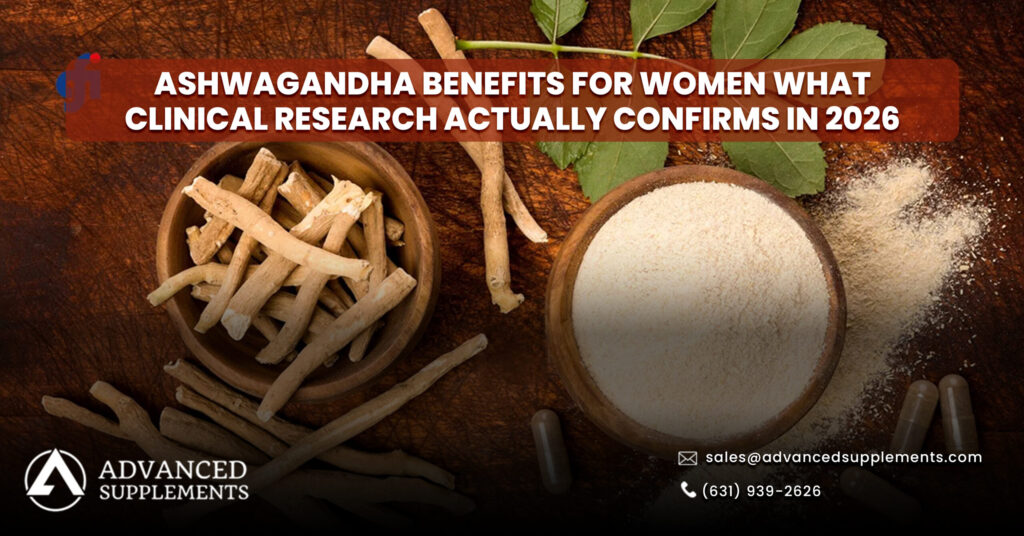
Ashwagandha benefits for women include cortisol reduction, better sleep, hormonal balance, sexual health support, and perimenopause relief. Clinical trials using Withania somnifera root extract standardized to 5% withanolides confirm these outcomes in female subjects. The proven daily dose is 300 mg to 600 mg. Ashwagandha for women works best taken consistently for 8 to 12 weeks.
What Ashwagandha Is and How It Works?
Ashwagandha, or Withania somnifera, is a shrub native to India and parts of northern Africa. Its root has been used in Ayurvedic medicine for over three millennia, primarily as what practitioners called a rasayana. That translates roughly to a compound taken to preserve vitality and slow the effects of stress on the body.
The active compounds are withanolides, a class of steroidal lactones found in the highest concentration in the root. These compounds interact with the hypothalamic-pituitary-adrenal axis, the system that governs cortisol production in response to stress. When the HPA axis is chronically overactivated, cortisol stays elevated past the point where it is useful. Ashwagandha appears to moderate that response rather than suppress it entirely, which is what puts it in the adaptogen category rather than the sedative one.
A 2024 systematic review and meta-analysis published in PubMed analyzing nine randomized controlled trials across 558 participants found statistically significant reductions in Perceived Stress Scale scores, Hamilton Anxiety Scale scores, and serum cortisol levels in groups taking ashwagandha compared to placebo. The cortisol reduction mean difference was 2.58 micrograms per deciliter. That is a real physiological shift, not a questionnaire artifact.
The Stress and Cortisol Connection Women Need to Understand
Cortisol is not the enemy. You need it in the morning to wake up and in short bursts to respond to actual threats. The problem for many women is that it stops cycling properly. It stays elevated through the evening, disrupts sleep onset, and creates a feedback loop where poor sleep raises cortisol the next day.
Ashwagandha good for women dealing with that pattern is not just a stress herb claim. The landmark Chandrasekhar study, available in full on PMC, followed 64 chronically stressed adults for 60 days. The group taking 300 mg of high-concentration full-spectrum ashwagandha root extract twice daily showed a 27.9% reduction in serum cortisol by day 60. The placebo group showed a 7.9% reduction. That 20-point gap is meaningful and was statistically significant at p equals 0.002.
What makes this relevant specifically to women is that elevated cortisol disrupts estrogen signaling, suppresses thyroid output, and worsens PMS symptom severity. Reducing cortisol does not just make you feel calmer. It removes a source of downstream hormonal disruption that affects cycle regularity, skin, weight distribution, and mood.
Ashwagandha Benefits for Female Sexual Health
This one surprises people. The connection between an adaptogen and sexual function is not intuitive until you understand that libido in women is heavily governed by the nervous system’s sense of safety and the hormonal environment around it.
Chronic stress kills desire. That is not a metaphor. Elevated cortisol blunts the hypothalamic signals that initiate sexual interest, and it competes directly with progesterone for the same receptor pathways. Bring cortisol down and the reproductive system often responds.
A prospective, randomized, double-blind, placebo-controlled trial published on PubMed enrolled 80 women between 18 and 50 years old who reported reduced sexual desire. After 8 weeks of taking ashwagandha root extract, women in the treatment group showed significant improvements across every sub-scale of the Female Sexual Function Index, including desire, arousal, lubrication, orgasm, and pain. The placebo group showed no comparable change.
Sleep Quality: Where Many Women Feel It First
Most women who start taking ashwagandha do not report feeling less stressed right away. What they notice first, often within the first two weeks, is that they fall asleep more easily and stay asleep longer.
A double-blind, randomized, placebo-controlled study published in the Journal of Ethnopharmacology tested ashwagandha root extract in both healthy volunteers and insomnia patients. The treatment group showed significant improvements in sleep onset latency, total sleep time, sleep efficiency, and how alert they felt the following morning. The improvements appeared faster than the cortisol changes, which suggests ashwagandha’s sedative withanolide activity operates through a somewhat separate mechanism from its HPA axis effects.
For women in perimenopause, where sleep disruption is frequently the first symptom to appear and the last to resolve, that early response to ashwagandha for women is often the most meaningful initial sign that the supplement is working.
Perimenopause, Hormones, and Why Adaptogens Help
Perimenopause is not just lower estrogen. It is a period of hormonal volatility where estrogen and progesterone fluctuate unpredictably before declining. The symptoms women experience, hot flashes, mood swings, cognitive fog, disrupted sleep, and reduced energy, are driven partly by those fluctuations and partly by how the stress response system amplifies them.
Ashwagandha benefits for female health during this transition have been studied in randomized controlled settings. Women taking ashwagandha root extract for 8 weeks reported fewer hot flashes, more stable mood, and better sleep quality compared to those on placebo. The researchers attributed the benefit to ashwagandha’s modulation of the HPA axis, which interacts with the hypothalamic thermoregulation center responsible for hot flashes. This is also where format choice starts to matter practically.
Women who want to take ashwagandha consistently through a multi-month perimenopausal transition tend to find capsules easier to maintain. A qualified capsule supplement manufacturer encapsulates standardized root extract at a fixed dose per unit, making it easy to maintain 600 mg daily without thinking about it. Powder works for women who prefer to blend their supplements into a morning drink, but the earthy, bitter taste of ashwagandha root requires skilled flavor masking from an experienced powder supplement manufacturer to be something people continue taking long-term.
Energy, Exercise Recovery, and Physical Performance
Ashwagandha good for women who train is supported by research that goes beyond stress management. The root’s anti-inflammatory properties and its effect on mitochondrial function have measurable consequences for physical performance.
A 2023 study published in PubMed following adults through an 8-week resistance training program found that the group taking standardized ashwagandha root extract showed significantly greater improvements in VO2 max, muscular strength, and recovery markers versus placebo.
Women in the study responded comparably to men across endurance and recovery outcomes. For women managing fatigue as a primary complaint, whether from overtraining, lifestyle stress, or perimenopausal energy shifts, the performance data adds another dimension to why this herb has held clinical interest.
What Brands and Manufacturers Need to Know
Ashwagandha is one of the fastest-growing segments in the women’s wellness supplement market. That growth creates opportunity and, inevitably, quality problems. Most of the clinical benefit data comes from studies using root extracts standardized to a minimum 5% withanolide concentration. Products that do not disclose withanolide content, or that use whole-root powder without standardization, cannot reliably deliver the doses that produced research results.
For brands building women’s health lines, ingredient traceability and extract standardization should be non-negotiable requirements in any manufacturing partnership. A supplement manufacturer working with ashwagandha must verify raw material identity and withanolide concentration from each incoming batch, maintain documented GMP records, and provide Certificates of Analysis on request.
A supplement contract manufacturer USA operating under domestic cGMP certification gives brand owners the regulatory documentation needed to enter retail channels, Amazon, and subscription box markets where quality verification has become a standard expectation rather than a differentiator.
Advanced Supplements manufactures capsule and powder ashwagandha supplement formats from a 60,000 square-foot cGMP-certified facility in Edgewood, New York. Certified by UL NPA and trusted by over 1,650 brands, their team provides full formulation support and private label capabilities for women’s health supplement lines.
Conclusion
The conversation around ashwagandha benefits for women has shifted meaningfully in the last five years. What was once framed as traditional herbal support is now backed by randomized, double-blind, placebo-controlled trials targeting female-specific outcomes from cortisol and sleep to sexual health and perimenopause management.
Ashwagandha benefits for female health are real, measurable, and practical. The herb is not a pharmaceutical. It does not override physiology. But taken consistently at a clinically validated dose from a quality-standardized extract, it gives the female stress response system enough support to start regulating itself more effectively.
Whether you are a woman choosing a daily supplement or a brand working with a supplement manufacturer to build a women’s wellness product, the same rule applies. The extract quality and the consistency of use matter more than anything on the marketing label. A supplement contract manufacturer in the USA that can document both is where every serious ashwagandha product for women should start.
Frequently Asked Questions
-
What are the top ashwagandha benefits for women?
The top ashwagandha benefits for women are cortisol reduction, improved sleep onset and quality, hormonal support during perimenopause, enhanced sexual health, and better physical energy and recovery. Each is backed by at least one randomized controlled trial in adult women.
-
Is ashwagandha good for women with anxiety?
Yes. Ashwagandha good for women managing anxiety works through HPA axis modulation, lowering the cortisol overactivation that drives anxious arousal. A 2024 meta-analysis across nine RCTs confirmed statistically significant reductions in Hamilton Anxiety Scale scores compared to placebo.
-
What is the correct ashwagandha dose for women?
The clinically tested dose is 300 mg of standardized root extract taken twice daily, totaling 600 mg per day. Some trials show benefit at a single 300 mg dose. The extract should state at least 5% withanolides on the label to align with research-grade material.
-
How long does ashwagandha take to work for women?
Sleep improvements often appear within two weeks. Cortisol reductions and mood changes are typically measurable by week four. Sexual health and hormonal benefits in most studies required the full 8-week protocol to reach statistical significance.
-
Can women take ashwagandha every day?
Yes. Daily use at 300 to 600 mg of standardized root extract is what clinical trials use and what produces measurable results. Ashwagandha is generally well tolerated with consistent use across 8 to 12 week trial periods.
-
Is ashwagandha safe during pregnancy?
No. Ashwagandha benefits for female health apply to non-pregnant women. During pregnancy, ashwagandha is not recommended. It has traditionally been classified as a uterine stimulant, and modern safety data in pregnancy does not exist. Pregnant women should avoid it entirely.
-
Which supplement format is better for women, capsule or powder?
Capsules from a reliable capsule supplement manufacturer suit most women best for daily consistency. Powder from a skilled powder supplement manufacturer works for those who prefer to blend ashwagandha into a drink, provided the taste is well masked.
-
Does ashwagandha help with perimenopause symptoms?
Yes. Clinical research shows that ashwagandha for women going through perimenopause reduces hot flash frequency and severity, stabilizes mood, and improves sleep quality compared to placebo. Benefits are linked to HPA axis regulation, not direct hormonal replacement.