

Not every supplement format belongs in every product. The decision between nanoparticle capsules and traditional capsule formats is a formulation and business question with measurable consequences for absorption, unit cost, regulatory positioning, and consumer expectations.
Nanoencapsulation is moving from pharmaceutical R&D into commercial supplement manufacturing faster than most brand owners realize. According to MarketsandMarkets, the food nanoencapsulation market is projected to grow from $991.4 million in 2025 to $1,856.8 million by 2030 at a 13.4% CAGR. Approximately 68% of nutraceutical manufacturers are now investing in nano-delivery systems. Understanding what the technology actually does, and when it is worth the cost, is now a core brand decision.
Advanced Supplements manufactures gelatin, vegetarian, and specialty capsule formats at our GMP-certified, FDA-registered US facility. Talk to our team about your project and get a quote in 48 hours.
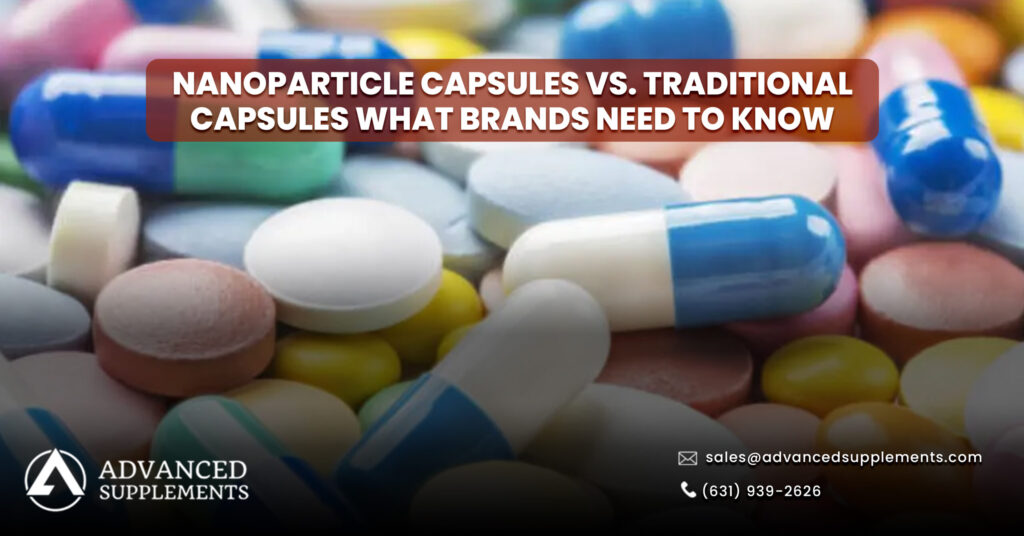
This article compares nanoparticle capsules and traditional supplement capsules, covering bioavailability differences, types of nanocarriers, which ingredients benefit most, manufacturing costs, FDA regulatory considerations, and when traditional capsules remain the better choice for supplement brands.
How Traditional Capsules Work?
Traditional supplement capsules are two-piece hard shell enclosures, either gelatin or hydroxypropyl methylcellulose (HPMC), filled with a powder, granule, or liquid. The capsule dissolves in the stomach or upper intestine, releasing its contents for absorption through the gastrointestinal wall.
This delivery system works well for water-soluble ingredients with adequate oral bioavailability. Vitamin C in a hard gelatin capsule, for example, dissolves efficiently and absorbs reliably without any delivery enhancement. The format is low-cost, well-understood by regulators, easy to manufacture at scale, and familiar to consumers.
For a large portion of the supplement market, traditional capsules remain the right choice for all those reasons. The limitation appears when the active ingredient is poorly water-soluble, unstable in gastric acid, or degraded before it reaches the absorption site in the small intestine. That is where standard capsule manufacturing encounters a ceiling that formulation alone cannot raise.
What Are Nanoparticle Capsules?
Nanoparticle capsules use nano-scale carrier systems, typically between 10 and 500 nanometers in diameter, to encapsulate active ingredients before they are placed into a capsule shell or delivered directly as a liquid, gel, or powder. The nanocarrier surrounds the ingredient, protects it from degradation during digestion, and carries it to the absorption site where it is taken up through mechanisms including endocytosis and lymphatic transport.
The result is that the active ingredient reaches circulation in a higher proportion than it would through standard oral delivery. A peer-reviewed study published in the International Journal of Molecular Sciences found that liquid crystalline nanoparticle formulations of omega-3 fatty acids delivered 1.7 to 2.3 times greater bioavailability of EPA and DHA compared to a standard soft capsule. Research on lipid nanoparticle platforms cited by Nutritional Outlook places the potential bioavailability advantage at up to six times for certain ingredient classes.
The delivery enhancement comes from four properties that nano-scale carriers provide: protection from gastric acid and enzymatic degradation, improved solubility for lipophilic ingredients, increased surface area for absorption, and in some carrier types, direct cellular uptake that bypasses first-pass hepatic metabolism.
The Four Main Nanocarrier Types in Supplement Manufacturing
Not all nanoparticle technology works the same way. Supplement brands evaluating this format need to understand the four carrier systems in commercial use because each one has different ingredient compatibility, manufacturing complexity, and cost implications.
Liposomes
Liposomes are spherical vesicles made from phospholipid bilayers, structurally similar to cell membranes. They can carry both water-soluble ingredients in their core and fat-soluble ingredients in their membrane. Liposomal delivery has the longest commercial track record in nutraceuticals. Vitamin C encapsulated in liposomes has been shown to be 1.77 times more bioavailable than standard oral vitamin C. Liposomes are well-suited to curcumin, glutathione, vitamin C, and B vitamins.
Solid Lipid Nanoparticles (SLNs)
Solid lipid nanoparticles use a solid lipid matrix at body temperature to carry fat-soluble actives. SLNs offer strong physical stability, controlled release profiles, and protection for ingredients sensitive to oxidation and heat. They are commercially used for coenzyme Q10, vitamin D, vitamin E, and certain botanical extracts. SLNs are the most scalable nanocarrier type for commercial supplement production.
Nanoemulsions
Nanoemulsions are oil-in-water or water-in-oil dispersions with droplet sizes between 20 and 500 nanometers. They improve the oral bioavailability of lipophilic ingredients by dramatically increasing surface area. Nanoemulsifications holds the largest market share in the food and supplement nanoencapsulation space due to its scalability with high-pressure homogenization and ultrasonic emulsification equipment that integrates into existing production lines.
Polymeric Nanoparticles
Polymeric nanoparticles use biodegradable polymers such as chitosan, alginate, or poly lactic-co-glycolic acid (PLGA) as carrier matrices. They provide the most precise controlled-release capability of any nanocarrier type, making them the preferred choice for targeted delivery and extended-release formulations. Manufacturing complexity is higher than lipid-based systems, and cost per unit reflects that.
Which Supplement Ingredients Benefit Most From Nanoencapsulation?
The value of nanoencapsulation is not uniform across ingredients. The candidates that consistently show meaningful bioavailability improvements are those that fail to absorb adequately in standard oral delivery because they are poorly water-soluble, unstable in the GI tract, or degraded before reaching the small intestine.
Fat-soluble vitamins A, D, E, and K are strong candidates because their absorption depends on lipid co-ingestion and bile salt emulsification, which nano-lipid carriers can replicate and enhance independently. Omega-3 fatty acids in nanoparticle form show clinically documented absorption gains. Curcumin is one of the most-studied examples, with oral bioavailability that is extremely low in standard form and substantially improved through nanoemulsion or liposomal delivery.
Coenzyme Q10, resveratrol, quercetin, and carotenoids including lycopene and beta-carotene share the same problem profile. They are commercially important ingredients with clinical evidence of function and bioavailability that limits what the consumer actually experiences. Probiotics represent a different case: the benefit of nanoencapsulation is protection from gastric acid and heat during manufacturing rather than absorption enhancement, which matters greatly for shelf stability and clinical viability.
A 2025 review published in Frontiers in Nutrition confirmed that over 85 new nutraceutical products featuring nanoencapsulation were introduced in 2023 alone, with the technology concentrated in vitamins, minerals, omega-3 fatty acids, antioxidants, and plant extracts.
Manufacturing Realities: Cost, Complexity, and Scale
Nanoencapsulation adds production cost. Brands evaluating this format should plan for unit cost increases of 20 to 50 percent over comparable traditional capsule production depending on the carrier system. Polymeric nanoparticle production carries the highest cost premium. Nanoemulsion production using established high-pressure homogenization equipment falls at the lower end of the range.
Scale is the other variable. Most nanoencapsulation technology was originally developed for pharmaceutical production at volumes that do not map directly to supplement contract manufacturing MOQs. The gap has narrowed significantly as dedicated supplement-focused nanoencapsulation manufacturing capacity has grown, but brands need to confirm their contract manufacturer has both the formulation capability and the production equipment for the specific carrier type they require.
Stability also works differently for nanoparticle formulations. Some nanocarrier systems are sensitive to temperature, light, and pH in ways that standard hard capsule contents are not. Packaging selection matters more, and stability testing protocols need to account for nanoparticle size distribution changes over the shelf life, not just potency degradation. When planning your custom supplement formulation around nanocarrier technology, stability data is a production requirement, not an optional step.
FDA Regulatory Considerations for Nano Supplement Products
The FDA does not maintain a separate regulatory approval pathway for dietary supplements using nanotechnology. Products are evaluated under the existing Dietary Supplement Health and Education Act (DSHEA) framework, which does not require pre-market approval. However, the FDA has issued guidance documents indicating that nano-scale ingredients may have different safety profiles from their conventional counterparts due to altered surface properties, reactivity, and absorption behavior.
For GRAS (Generally Recognized as Safe) ingredients used in nanoencapsulated form, the safety determination made for the conventional material does not automatically extend to the nano version. Brands using novel nanocarrier systems with ingredients that do not have an established safety record at nano-scale should conduct safety assessments before commercialization. Working with a contract manufacturer that understands nano-ingredient documentation requirements is an important part of regulatory readiness for this format.
When Traditional Capsules Remain the Right Choice
Nanoencapsulation is not the right answer for every supplement. For water-soluble, readily absorbed ingredients such as most B vitamins, vitamin C at standard doses, and many amino acids, standard capsule delivery achieves the bioavailability the formulation needs. Adding nanoencapsulation to these products increases cost without producing a measurable benefit for the consumer.
Traditional capsules also carry competitive advantages that nanoparticle formats do not: lower unit cost, broader manufacturing availability, simpler stability requirements, cleaner label declarations that align with consumer clean-label preferences, and an established regulatory footprint. For supplement brands building accessible, affordably priced products or entering new categories, gelatin and vegetarian capsule manufacturing remains the most cost-effective and operationally straightforward delivery format available.
The Brand Decision: A Practical Framework
The decision between nanoparticle and traditional capsule formats follows a clear logic. Start with the ingredient. If the active ingredient is well-absorbed in standard oral delivery and does not degrade in the GI tract, traditional capsules are the efficient choice. If the ingredient is poorly soluble, unstable in gastric acid, or shows clinical evidence of low oral bioavailability, nanoencapsulation should be evaluated against the specific carrier types that have demonstrated efficacy for that ingredient class.
Then evaluate the market position. Premium-positioned products with efficacy claims that require superior delivery technology can absorb the unit cost premium of nanoencapsulation. Entry-level or high-volume products where price is a primary conversion factor typically cannot. A product with a $15 shelf price and nanoencapsulation costs that double the unit manufacturing cost has a structural margin problem regardless of the quality of the delivery technology.
Finally, confirm manufacturing capability before committing to a formulation. The supplement contract manufacturer handling your product needs to have validated nanoencapsulation process controls, stability testing protocols appropriate to the carrier type, and the quality documentation infrastructure to support a nano-ingredient product through retail compliance and regulatory review. Confirming those capabilities with your supplement manufacturer before finalizing your formulation saves significant time and cost.
Frequently Asked Questions
What are nanoparticle capsules in supplement manufacturing?
Nanoparticle capsules use nano-scale carriers under 100nm to improve ingredient bioavailability, stability, and protection during digestion.
Are nanoparticle capsules more bioavailable than traditional capsules?
Research shows nanoencapsulated ingredients can be 1.7 to 6 times more bioavailable than the same ingredients in standard capsule form.
Which supplement ingredients benefit most from nanoencapsulation?
Fat-soluble vitamins, omega-3s, curcumin, and CoQ10 benefit most because they are poorly absorbed in standard capsule or tablet form.
How much does nanoparticle supplement manufacturing cost?
Nanoencapsulation adds 20 to 50 percent to unit cost compared to standard capsule production, depending on the nano carrier technology used.
Are nanoparticle supplements regulated by the FDA?
The FDA evaluates nano supplements under existing DSHEA frameworks. GRAS status for conventional forms does not automatically cover nano versions.
When should a brand choose traditional capsules over nanoparticle technology?
Traditional capsules are right for well-absorbed, water-soluble ingredients where nanoencapsulation would add cost without measurable benefit.