

Sublingual tablets dissolve under the tongue in 1 to 3 minutes and absorb through the oral mucosa directly into the bloodstream. Traditional tablets dissolve in the stomach and pass through the liver before reaching circulation. Sublingual delivery is faster and bypasses first-pass metabolism. Traditional tablets support higher doses and a wider range of ingredients. The better format depends on whether your ingredient degrades in the GI tract or liver.
Need help choosing between sublingual and traditional tablets? Talk to our team and find the best option for your formula.
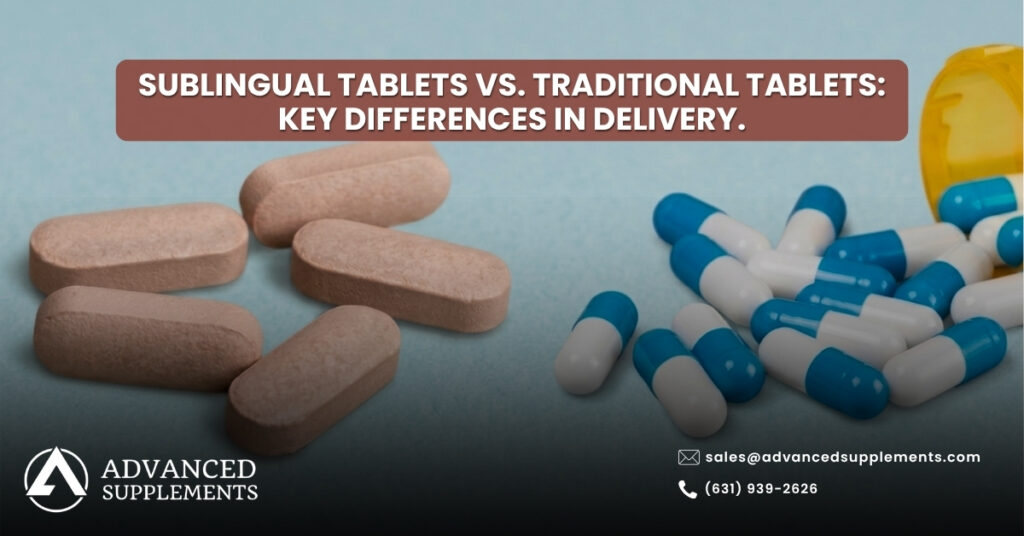
What Makes Sublingual Tablets Different from Traditional Tablets?
Sublingual tablets are placed under the tongue and held there until they dissolve. Active ingredients cross the sublingual mucosa and enter the capillary network beneath. They reach systemic circulation without passing through the stomach or small intestine. Traditional tablets are swallowed, dissolved in the stomach, and absorbed through the GI tract.
The delivery route is the defining difference. Sublingual delivery is mucosal absorption. Traditional oral delivery is gastrointestinal absorption. These two routes produce different onset times, different bioavailability profiles, and different formulation requirements. For supplement brands, that difference determines which ingredients are viable candidates for each format.
How Does Sublingual Absorption Work Through the Oral Mucosa?
The floor of the mouth beneath the tongue is lined with non-keratinized mucosal tissue. Non-keratinized tissue lacks the tough outer layer that makes skin impermeable. This mucosal surface is richly supplied with capillaries sitting close to the surface. Compounds that dissolve here diffuse across the thin membrane and enter circulation directly.
Absorption through this pathway is fast. Active compounds can reach systemic circulation in as little as 2 to 5 minutes. This compares to 30 to 60 minutes for a swallowed tablet reaching peak plasma concentration. A 2017 review published in the Journal of Pharmaceutical and Clinical Research confirmed that sublingual tablets achieve rapid onset of action and higher bioavailability due to fast disintegration and direct mucosal absorption.
The sublingual mucosa has a pH range of approximately 6.0 to 7.5. Formulations designed for sublingual delivery account for this pH to optimize disintegration speed. Excipient selection, particle size, and tablet hardness all affect how quickly the tablet dissolves.
What Is First-Pass Metabolism and Why Does It Matter for Supplement Delivery?
First-pass metabolism is the process by which orally swallowed compounds are partially broken down by the liver before reaching systemic circulation. A swallowed tablet is absorbed in the intestine, transported via the portal vein to the liver, and metabolized there. What remains after this process is the fraction that reaches the bloodstream.
For some ingredients, first-pass hepatic metabolism reduces bioavailability significantly. Vitamin B12 absorption decreases in older adults due to reduced intrinsic factor production in the stomach. Melatonin undergoes extensive first-pass metabolism, with oral bioavailability ranging from just 3 to 33 percent across studies. PMC research on sublingual and buccal delivery documents that bypassing hepatic first-pass metabolism through sublingual administration provided pharmacokinetic advantages comparable to intravenous delivery for certain compounds.
Sublingual delivery bypasses this step entirely. Compounds absorbed through the oral mucosa enter systemic circulation directly. They do not travel to the liver first. This is the primary bioavailability advantage of sublingual delivery over traditional oral tablets.
Key Takeaway: Sublingual tablets absorb in 2-5 minutes through the oral mucosa. Traditional tablets absorb in 30-60 minutes through the GI tract. Sublingual bypasses first-pass liver metabolism. Bioavailability advantage is ingredient-dependent and strongest for compounds with high hepatic extraction ratios.
Which Ingredients Work Best in Sublingual Tablets?
Sublingual delivery suits ingredients that meet specific criteria. The compound must be active at a small dose that fits within a dissolving tablet. It must be able to cross mucosal tissue through passive diffusion. And it must benefit from bypassing the GI tract or hepatic metabolism.
Vitamin B12
Sublingual B12 is one of the most evidence-supported supplement applications for mucosal delivery. Older adults and individuals with low stomach acid cannot absorb sufficient B12 through the standard intrinsic-factor pathway. Sublingual administration delivers B12 directly into circulation without relying on gastric intrinsic factor. Clinical data supports sublingual B12 as an effective alternative to intramuscular injections for correcting deficiency.
Melatonin
Melatonin is highly degraded by first-pass metabolism. Oral bioavailability varies from 3 to 33 percent, making dose prediction difficult. Sublingual delivery produces a faster and more consistent plasma concentration profile. Onset within 20 to 40 minutes sublingual versus 60 to 90 minutes for a swallowed tablet matters for sleep onset applications.
Vitamin D3 and Vitamin K2
Fat-soluble vitamins traditionally absorb better when taken with dietary fat. Sublingual delivery in a lipid-based dissolving matrix provides an alternative pathway. This is particularly relevant for consumers with fat malabsorption conditions. For standard vitamin D3 supplementation in healthy adults, the oral capsule format remains the established choice at lower cost.
Magnesium and Electrolytes
Sublingual magnesium is used for rapid symptom relief in cramp and tension applications. The onset advantage is meaningful when the consumer needs fast action. Standard oral magnesium supplements remain more cost-effective for daily maintenance dosing. Sublingual is appropriate when speed of effect is the primary formulation goal.
NMN and NAD+ Precursors
Sublingual NMN is commercially popular, but the evidence is nuanced. Oral NMN reaches the bloodstream via dedicated intestinal transporters within 10 minutes. The benefit of sublingual delivery over oral for NMN specifically is not established by clinical comparison studies. Brands choosing sublingual NMN should frame the format as a convenience feature rather than a clinically proven superiority claim.
Key Takeaway: Best sublingual candidates: vitamin B12 (especially for malabsorption), melatonin (first-pass bypass), and fast-acting minerals. Not every ingredient benefits equally. NMN and water-soluble vitamins may not show measurable advantage over standard oral delivery.
What Are the Formulation Requirements for Sublingual Tablets?
Sublingual tablets must disintegrate rapidly under the tongue without swallowing. They typically disintegrate within 1 to 3 minutes in the small volume of saliva present. Achieving this requires specific excipient selection that differs significantly from standard tablet manufacturing.
Superdisintegrants are the critical excipient class in sublingual tablet formulation. Crospovidone, sodium starch glycolate, and croscarmellose sodium are the most used options. These agents expand rapidly on contact with moisture, breaking the tablet matrix apart quickly. Peer-reviewed sublingual tablet formulation research confirms that superdisintegrant inclusion is the single most important formulation variable for achieving rapid disintegration and high bioavailability.
Mannitol is commonly used as a filler and sweetener for sublingual tablets. It provides a cool, pleasant mouthfeel that supports patient compliance. Tablet hardness must be lower than standard swallowed tablets to permit fast disintegration. This creates a manufacturing challenge: the tablet must be strong enough to survive packaging and handling, yet soft enough to dissolve in seconds under the tongue.
Dose size is a hard constraint for sublingual formulation. A tablet sitting under the tongue must be small enough for comfort. Most sublingual supplements deliver doses below 10 milligrams of active ingredient per tablet. High-dose ingredients, including many minerals and protein-adjacent compounds, cannot be delivered sublingually at therapeutic doses in a single tablet.
How Does Sublingual Tablet Manufacturing Differ From Traditional Tablet Production?
Both sublingual and traditional tablets are produced by direct compression or wet granulation. The equipment overlap is significant. The difference is in the tooling, compression force, and excipient formulation rather than the production line type.
Sublingual tablets require lower compression force than standard swallowed tablets. Lower compression produces a more porous tablet matrix that water can penetrate quickly. Standard hardness targets for swallowed tablets range from 4 to 10 kiloponds. Sublingual hardness targets run lower, typically 2 to 4 kiloponds, to facilitate fast disintegration.
Coating is not applied to sublingual tablets. Standard tablets are often film-coated for taste masking or moisture protection. A coating on a sublingual tablet would slow or prevent mucosal absorption. Flavoring must be incorporated directly into the tablet matrix instead. Understanding the full supplement manufacturing process including granulation and compression, is relevant context for brands evaluating both tablet formats.
When Do Traditional Tablets Outperform Sublingual Delivery?
Traditional tablets handle a wider range of ingredient types, doses, and release profiles. Any ingredient requiring a dose above 50 to 100 milligrams per serving is not a practical sublingual candidate. Multivitamin formulas, protein supplements, and high-dose minerals all require oral delivery formats.
Traditional tablets also support modified-release profiles: enteric coating, film coating, and time-release matrices. These are unavailable in sublingual format. For acid-sensitive ingredients where intestinal delivery is the goal, delayed release capsule formats and enteric-coated tablets are more appropriate than sublingual. For ingredients where first-pass metabolism is not a problem and doses are high, traditional tablets are the operationally simpler choice at lower cost per unit.
Sublingual vs. Traditional Tablets: Side-by-Side Comparison
| Factor | Sublingual Tablet | Traditional Tablet |
| Absorption route | Oral mucosa, capillaries | GI tract, portal vein |
| First-pass metabolism | Bypassed | Applies |
| Onset time | 2 to 5 minutes | 30 to 60 minutes |
| Max practical dose per tablet | Under 10 to 20 mg typically | Hundreds of mg possible |
| Disintegration time target | 1 to 3 minutes | 15 to 30 minutes |
| Tablet hardness (kiloponds) | 2 to 4 | 4 to 10 |
| Coating applied | No | Yes (film, enteric) |
| Modified/delayed release | Not available | Available |
| Consumer compliance format | Dissolves under tongue | Swallowed with water |
| Unit cost vs capsule | Similar to standard tablet | Similar to capsule |
| Best for | B12, melatonin, fast-acting | High-dose, full-spectrum |
Which Format Should Supplement Brands Choose?
Choose sublingual when the active ingredient suffers significant first-pass degradation. Vitamin B12 deficiency supplementation and melatonin sleep products have the clearest clinical rationale for sublingual delivery. Fast-acting magnesium and electrolyte applications also suit this format. The dose must fit within the physical constraints of a sublingual tablet the consumer holds under the tongue.
Choose traditional tablets when the dose is above 20 milligrams, when the formula requires a coating, or when the ingredient absorbs adequately through the GI tract. For custom supplement formulation decisions, the choice between sublingual and traditional tablet format should be made before stability testing begins. Reformulating from one tablet type to the other after validation resets both the timeline and the testing budget.
Key Takeaway: Sublingual wins when first-pass metabolism limits bioavailability and dose is small. Traditional tablets win when dose is high, coating is required, or ingredient absorbs well through the GI tract. Decide format before, not after, committing to stability testing.
Conclusion
The difference between sublingual and traditional tablets is not a matter of one format being superior. It is a question of fit between the delivery mechanism and the ingredient’s pharmacokinetics. Sublingual delivery is the right call for a specific set of ingredients: those degraded by first-pass metabolism, those with documented GI absorption limitations, and those where a fast onset time is a defined product benefit.
Traditional tablets remain the correct choice for high-dose formulas, coated dosage forms, and the majority of supplement ingredients that absorb adequately through the gastrointestinal tract. Making the format decision before stability testing begins is the most important timeline and budget protection a brand can apply to the development process. Changing it after validation is expensive and time-consuming regardless of the reason.
Work With Our US Tablet Manufacturing Team
Advanced Supplements is a GMP-certified, FDA-registered supplement manufacturer in the United States. We produce sublingual tablets, traditional tablets, and capsule formats for pharmaceutical and nutraceutical brands. Every production run includes batch documentation, in-process testing, and a certificate of analysis.
Tell us your active ingredient, target dose, and desired onset time. Our formulation team will confirm whether sublingual or traditional tablet format is the right fit and send a production quote within one business day.
Frequently Asked Questions
What is a sublingual tablet and how does it work?
A sublingual tablet dissolves under the tongue, allowing ingredients to absorb directly into the bloodstream for faster effects and bypassing digestion.
Are sublingual tablets more bioavailable than traditional oral tablets?
For some ingredients, yes. They bypass first-pass liver metabolism, improving absorption and providing faster, more consistent blood levels.
Which supplement ingredients are best suited for sublingual tablets?
Vitamin B12 and melatonin are ideal. Some vitamin D3 and K2 formulas also work well, especially for people with absorption issues.
What are the formulation requirements for sublingual tablets?
They need fast-dissolving ingredients, low hardness, pleasant taste, and no coating so they can dissolve under the tongue within minutes.
Can sublingual tablets be manufactured on standard tablet compression equipment?
Yes. Standard tablet presses can be used, with lower compression force and no coating step. Testing is required before release.
When should a supplement brand choose traditional tablets over sublingual tablets?
Choose traditional tablets for high-dose ingredients, coated formulas, modified-release products, or nutrients that absorb well in the gut.