

If you are developing a dietary supplement brand and tablets are part of your product lineup, understanding the tablet manufacturing process gives you a significant advantage. It helps you ask the right questions, set realistic timelines, and choose a contract tablet manufacturing partner who operates at the standard your brand demands.
This guide walks through every stage of dietary supplement tablet manufacturing, from raw material intake to finished product release, so you know exactly what happens before your product reaches a customer.
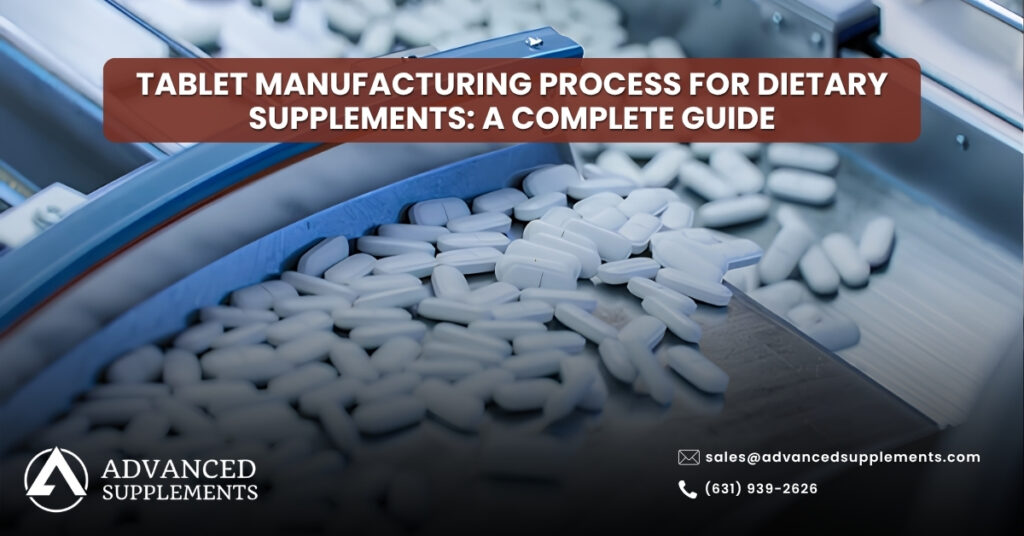
The tablet manufacturing process for dietary supplements follows 8 steps: raw material testing, granulation, tablet compression, film or enteric coating, blend uniformity testing, dissolution and disintegration testing, and final packaging with a supplement facts panel. Each step runs under cGMP standards inside an FDA-registered facility.
Ready to manufacture your supplement tablets?
Advanced Supplements handles everything from custom formulation to packaged, shelf-ready product. Get your free quote from our team today.
What Is the Tablet Manufacturing Process for Dietary Supplements?
The tablet manufacturing process for dietary supplements is a series of controlled production steps that transforms raw active ingredients and excipients into a compressed, coated, and packaged dosage form. Unlike capsules or powders, tablets require more precise engineering. Ingredient particle size, moisture content, compressibility, and blend uniformity all affect the final product’s hardness, dissolution rate, and shelf stability. A professional tablet supplement manufacturer controls every one of these variables across every batch.
The process runs inside a cGMP tablet manufacturing facility registered with the FDA. Every step generates documentation that traces each ingredient through weighing, blending, compression, coating, and packaging. That documentation becomes your certificate of analysis and supports your supplement facts panel claims at retail and online. Learn more about our full contract manufacturing services at Advanced Supplements.
The 8 Steps of Dietary Supplement Tablet Manufacturing
Step 1: Raw Material Sourcing and Ingredient Testing
The tablet manufacturing process starts before anything enters the production floor. Every raw material arrives with a supplier certificate of analysis, and a qualified laboratory runs independent identity testing on each ingredient before it is accepted into the facility, following FDA dietary supplement regulations. This includes organoleptic testing, chemical assay, heavy metal screening, and microbiological analysis.
At Advanced Supplements, no active ingredient or excipient enters our cGMP tablet manufacturing lines without passing incoming raw material testing protocols. Choosing a tablet supplement manufacturer who skips this step puts your entire batch at risk before compression even begins.
Step 2: Weighing, Dispensing, and Excipient Preparation
Once raw materials are approved, each ingredient is weighed to the exact specification in your formulation brief. Weighing rooms inside an FDA registered tablet manufacturing facility are maintained under positive pressure with controlled humidity and temperature to prevent cross-contamination between formula runs.
Excipients are dispensed alongside your active ingredients at this stage. In tablet manufacturing, excipients perform critical functional roles. Binders hold the compressed tablet together. Disintegrants cause the tablet to break apart in the digestive tract and release active ingredients for absorption, as defined by USP excipient standards. Lubricants prevent powder blend from sticking to punch and die tooling during compression. Fillers bring each tablet to its target weight when the active ingredient dose is small. Selecting the right excipient combination is one of the most technical decisions in custom tablet formulation.
Step 3: Granulation – Wet Granulation, Dry Granulation, or Direct Compression
Granulation transforms a powder blend into granules with the flow and compressibility properties needed for consistent tablet compression. There are three primary approaches used in dietary supplement tablet manufacturing, and the right choice depends on your active ingredients and their physical characteristics.
Wet granulation combines the powder blend with a liquid binder solution to form granules, which are then dried and milled to a uniform particle size, a method well-documented in published granulation research. It produces dense, well-bonded granules that compress consistently and deliver tablets with excellent hardness and low friability. It is preferred for high-dose active ingredients or blends that do not flow well in dry form.
Dry granulation uses mechanical force to compact the powder blend into ribbons or briquettes, which are then milled into granules without adding any liquid. This granulation process is used when active ingredients are sensitive to moisture or heat. It is common in vitamin C tablet manufacturing and other moisture-sensitive formulas.
Direct compression skips granulation entirely and compresses the powder blend directly into tablets. This method is faster and lower cost, but requires active ingredients with inherently good flow and compressibility. A qualified tablet supplement manufacturer will confirm which method fits your specific formulation before production begins.
Step 4: Blending and Blend Uniformity Testing
After granulation, the granules are blended with any remaining excipients that must be added after the granulation step. Lubricants are almost always added here because over-blending weakens tablet hardness. Blend uniformity testing at this stage confirms that each active ingredient is distributed evenly throughout the blend before any material loads into the tablet press.
Blend uniformity is a regulatory expectation in cGMP tablet manufacturing. Tablets sampled from the beginning, middle, and end of a compression run must all contain the labeled amount of active ingredients within an accepted variance. Poor blending causes dose variation between tablets in the same bottle, which is a quality failure and a regulatory risk.
Step 5: Tablet Compression
Tablet compression is the step where granules or powder blends are fed into a rotary tablet press and formed into tablets by applying force through upper and lower punches into a die. The die determines the tablet’s shape, and the punch force determines its hardness.
During a compression run, in-process quality technicians monitor tablet weight variation, thickness, hardness, and friability testing at defined intervals. Tablet weight variation confirms whether each tablet contains the correct amount of active ingredient. Friability testing measures how much weight a batch of tablets loses when tumbled in a drum, which reflects how fragile the tablets are under real-world shipping and handling conditions.
Step 6: Tablet Coating – Film Coating and Enteric Coating
Most dietary supplement tablets benefit from coating after compression. There are two primary coating types used in dietary supplement tablet manufacturing.
Film coating applies a thin polymer film over the tablet surface. Film coated tablets are easier to swallow, mask bitter flavors, improve appearance, and offer moisture protection that extends shelf life. Film coating runs in a rotating coating pan where tablets tumble while a spray system applies the coating solution evenly across all surfaces.
Enteric coating applies a polymer that resists gastric acid and only dissolves in the higher pH of the small intestine. Enteric coating is used when the active ingredient is damaged by stomach acid, irritates the stomach lining, or when delayed release improves bioavailability. Probiotic tablet manufacturing frequently uses enteric coating to protect live organisms through the stomach environment.
Step 7: Quality Control, Third Party Testing, and Batch Release
Before any tablet batch ships, it completes a full finished product quality control review. This includes potency testing to verify each active ingredient is present at the labeled dose, dissolution testing to confirm the tablet releases the active ingredient within the specified time window, disintegration testing, microbiological testing, heavy metal analysis, and banned substance testing for sports supplement tablet brands.
At Advanced Supplements, every tablet batch is third party tested before release. The certificate of analysis we provide documents every result and gives your buyers, retailers, and sport organization contacts the verification they need. Our certified manufacturing protocols and cGMP tablet manufacturing documentation meet the requirements of major sport federations, military nutrition programs, and large supplement retailers.
Step 8: Packaging, Labeling, and Fulfillment
Released tablets move into packaging with a verified supplement facts panel and required certifications on the label. We produce private label tablets in bottles, blister packs, and sample sizes depending on your retail channel and distribution model. Label accuracy is verified against your approved artwork before any production lot is sealed and shipped.
Advance Supplements private label supplement programs include complete label compliance review, supplement facts panel generation, and finished product photography support for brands launching on Amazon, at retail, or through direct-to-consumer channels.
Types of Tablets in Dietary Supplement Manufacturing
A tablet supplement manufacturer produces several distinct tablet formats, each suited to different formulas and consumer needs.
Compressed Tablets
Compressed tablets are the standard uncoated format produced directly by the tablet press. They are the lowest cost tablet format and work well for formulas with no taste issues and stable active ingredients that do not require enteric coating or specialized release mechanisms.
Chewable Tablets
Chewable tablets are softer tablets formulated to be chewed rather than swallowed whole. They require different binder and flavoring excipients and are common in children’s supplement lines and sports nutrition brands targeting athletes who prefer convenience over swallowing multiple capsules per serving.
Effervescent Tablets
Effervescent tablets dissolve in water and release carbon dioxide when added to a glass. They require strict moisture control throughout the tablet manufacturing process because the effervescent reaction can begin prematurely in high-humidity conditions, causing product quality failures before packaging is complete.
Sublingual Tablets
Sublingual tablets dissolve under the tongue for direct absorption into the bloodstream, bypassing first-pass liver metabolism. This format improves bioavailability for certain active ingredients and is used in specialized supplement lines targeting performance, recovery, and hormonal health categories.
Controlled Release Tablets
Controlled release tablets use specific excipient systems to slow down or stage the release of active ingredients over time. Stability testing is critical for controlled release formats to confirm the release profile stays consistent throughout the product’s full shelf life. These tablets are common in iron supplement manufacturing and certain vitamin B formulations.
Why Choose Advanced Supplements for Tablet Manufacturing?
Advanced Supplements operates an FDA-registered tablet manufacturing facility running full cGMP tablet manufacturing protocols on every production run. Our custom tablet formulation team works with your active ingredients to identify the right granulation process, excipient system, and coating strategy before a single pound of raw material is committed to production.
We serve sports nutrition brands requiring certified tablet sports supplement manufacturer documentation, private label tablets for brands launching their first SKU, and established brands scaling into large format production. Our third-party tested, certificate of analysis documentation covers potency, microbiological safety, heavy metals, dissolution testing, and disintegration testing on every single batch we produce.
Frequently Asked Questions
What is the tablet manufacturing process for dietary supplements?
The tablet manufacturing process for dietary supplements follows eight stages: raw material testing, weighing and dispensing, granulation, blending with blend uniformity verification, tablet compression, coating, quality control with third party tested screening, and packaging with a verified supplement facts panel. Every stage runs under cGMP tablet manufacturing standards inside an FDA registered tablet manufacturing facility.
What is the difference between wet granulation, dry granulation, and direct compression?
Wet granulation uses a liquid binder to form granules and is preferred for high-dose or poorly flowing ingredients. Dry granulation uses mechanical compaction and suits moisture-sensitive active ingredients. Direct compression skips granulation entirely and compresses the powder blend directly, which works for ingredients with good natural flow and compressibility. A qualified tablet supplement manufacturer selects the method that fits your specific formula.
How long does tablet manufacturing take for a new formula?
A new custom tablet formulation project typically takes 10 to 14 weeks from approved formulation brief to finished product release. This includes raw material sourcing and testing, granulation process development, pilot tablet compression, film coating or enteric coating trials, and full quality control testing before the certificate of analysis is issued for the production batch.
What quality tests does a tablet supplement manufacturer run on each batch?
A qualified tablet supplement manufacturer runs potency testing, dissolution testing, disintegration testing, tablet hardness testing, friability testing, tablet weight variation analysis, microbiological screening, heavy metal testing, and stability testing. Every result is documented in the certificate of analysis issued for that production lot before shipment.