

The global empty capsule market is projected to grow from $2.96 billion in 2024 to $6.38 billion by 2034, reflecting an 8.0% compound annual growth rate. This growth is driven by increasing consumer demand for both traditional gelatin and plant-based vegan capsules.
Brand owners must understand the key differences between these capsule types to make informed manufacturing decisions. This guide examines vegan vs gelatin capsules across critical factors including material composition, stability, cost, consumer preferences, and market positioning.
Choose the right capsule for your brand. Advanced Supplements helps you select, source, and produce vegan or gelatin capsules that meet quality, cost, and market demand.
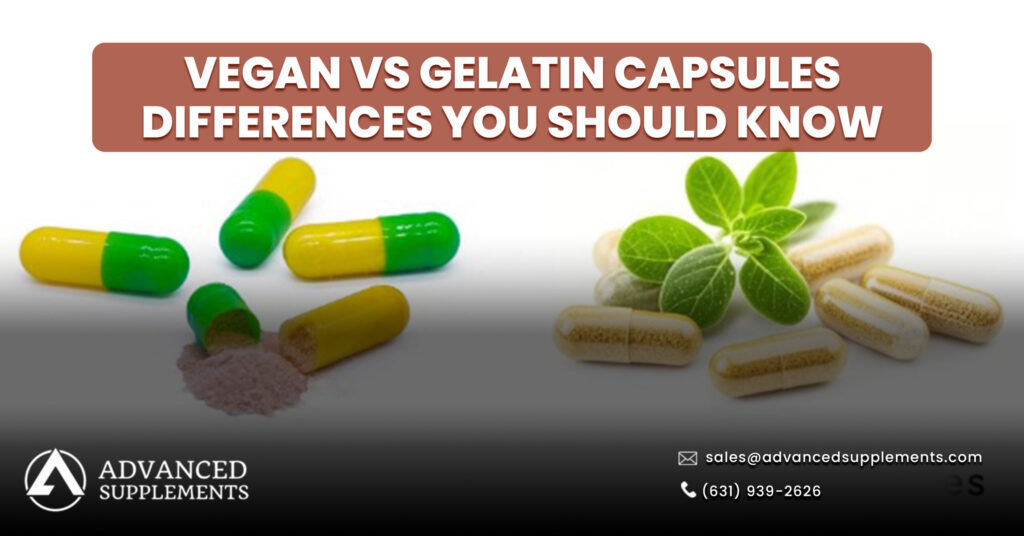
Gelatin capsules are made from animal-derived collagen, cost 30% less to manufacture, and dissolve fastest in 15-30 minutes, but their 13-16% moisture content makes them unsuitable for vegetarians, vegans, and moisture-sensitive ingredients like probiotics. Vegan HPMC capsules are 100% plant-based, contain only 2-6% moisture, and remain stable up to 80°C, automatically meeting vegetarian, vegan, Halal, and Kosher requirements, though they cost 20-40% more. Both dissolve effectively for nutrient absorption, so the right choice depends on target market dietary needs, ingredient stability requirements, and budget rather than performance differences.
Gelatin Capsule Composition and Manufacturing
Gelatin capsules are made from gelatin, a protein derived from collagen found in animal tissues. The gelatin is typically extracted through hydrolysis of collagen from bovine hide, pork skin, or fish bones. According to industry data, gelatin capsules currently hold 73.5% of the global capsule market share.
The manufacturing process is well-established and cost-efficient. Gelatin gets dissolved in water, mixed with plasticizing agents like glycerol, and formed into two-piece capsule shells through a dipping process. This mature production technology keeps manufacturing costs 30% lower than alternative materials.
Gelatin capsules contain 13-16% moisture content naturally. This maintains capsule flexibility and prevents brittleness. The protein structure provides excellent mechanical strength and fast dissolution in the stomach, typically within 15-30 minutes. Working with experienced supplement manufacturers helps navigate formulation considerations.
Vegan HPMC Capsule Materials and Production
Vegan capsules, also called vegetarian capsules or HPMC capsules, are made from hydroxypropyl methylcellulose, a plant-derived polymer. HPMC is extracted from cellulose found in wood pulp or cotton fibers through chemical modification that improves solubility.
According to research published in PMC, HPMC capsule shells contain only 2-6% moisture content compared to gelatin’s 13-16%. This significantly lower moisture makes vegan capsules less hygroscopic and more resistant to environmental conditions.
The HPMC capsule market is growing rapidly, projected to reach $1.01 billion by 2032 as demand increases for plant-based supplements. Vegan capsules are 100% plant-derived, making them suitable for vegetarians, vegans, and consumers with religious dietary restrictions, including Halal and Kosher requirements. Despite higher costs, vegan capsules offer distinct advantages for moisture-sensitive formulations.
Moisture Content and Stability Differences
Moisture content represents the most significant physical difference between vegan and gelatin capsules, directly impacting product stability and shelf life.
Gelatin capsules maintain 13-16% equilibrium moisture content. According to pharmaceutical research data, this high moisture creates compatibility issues with moisture-sensitive ingredients. Studies show that when gelatin capsules containing acetylsalicylic acid were stored at 60°C for 2 weeks, drug potency decreased to 85%. In contrast, HPMC capsules maintained above 95% potency under identical conditions.
Vegan HPMC capsules contain only 2-6% moisture content and exhibit lower hygroscopicity. This means they absorb less moisture from the environment and transfer less moisture to encapsulated ingredients. Temperature and humidity resistance differs dramatically.
Gelatin capsules degrade above 60°C and become sticky in high humidity above 70%. HPMC capsules maintain stability up to 80°C and resist deformation even at 80% relative humidity. Understanding the quality standards for capsule supplement manufacturing helps ensure proper material selection.
Dissolution and Bioavailability Comparison
Dissolution rate affects how quickly nutrients become available for absorption after consumption. Both capsule types dissolve effectively but show different characteristics.
Gelatin capsules dissolve rapidly in the stomach, typically within 15-30 minutes at body temperature. The protein structure breaks down quickly in acidic gastric fluid, making gelatin ideal for immediate-release formulations. However, gelatin solubility decreases significantly below 30°C, potentially affecting dissolution with cold water consumption.
Vegan HPMC capsules dissolve slightly slower than gelatin, typically within 20-40 minutes in the stomach. According to pharmaceutical testing data, this modest delay rarely affects clinical outcomes. HPMC capsules maintain consistent dissolution across wider temperature ranges and show less variation based on stomach pH. Both capsule types can be modified for delayed-release applications, though HPMC capsules naturally resist gastric acid better.
Dietary and Religious Considerations
Consumer dietary preferences and religious requirements significantly influence capsule selection for brand positioning and market reach.
Gelatin capsules are derived from animal sources, making them unsuitable for vegetarians, vegans, Muslims requiring Halal certification, and Jews needing Kosher certification. Fish gelatin offers a partial solution but remains unsuitable for vegetarians and vegans while costing more than bovine or porcine gelatin.
Vegan HPMC capsules solve these dietary restrictions completely. They are 100% plant-based, automatically qualifying as vegetarian, vegan, Halal, and Kosher without requiring special certifications. Market research shows 3.3% year-over-year growth in vegan capsule market share compared to 2% for gelatin, reflecting increasing consumer preference for plant-based options. Understanding how to find the right supplement manufacturer includes verifying their vegan capsule capabilities and certifications.
Environmental Impact and Sustainability
Environmental considerations increasingly influence consumer purchasing decisions, making capsule sustainability a relevant brand differentiation factor.
Gelatin production requires significant resources because it depends on animal agriculture. Raising livestock for collagen extraction requires land, water, feed, and energy throughout the supply chain. However, gelatin does utilize byproducts from meat industry processing that would otherwise become waste.
Vegan HPMC capsules derive from renewable plant materials including wood pulp and cotton fibers. Plant cellulose production generally requires less water, land, and energy compared to animal agriculture. Manufacturing processes for HPMC capsules typically consume less energy and generate lower greenhouse gas emissions. Both capsule types are biodegradable, though gelatin decomposes more rapidly. Working with custom supplement manufacturer partners who prioritize sustainable practices strengthens environmental positioning.
Manufacturing Cost and Pricing Implications
Cost differences between vegan and gelatin capsules significantly impact product pricing and profit margins.
Gelatin capsules are the most cost-effective option due to established manufacturing processes. Empty gelatin capsules cost approximately $0.02-0.04 per unit depending on size. Minimum order quantities for gelatin capsules are typically lower because most manufacturers stock standard sizes in high volumes.
Vegan HPMC capsules cost 20-40% more than equivalent gelatin capsules. Empty vegan capsules typically run $0.025-0.055 per unit. For a product containing 60 capsules per bottle, the vegan capsule premium adds approximately $0.30-0.90 per bottle to manufacturing costs.
Understanding variables that impact manufacturing costs helps optimize product development budgets. Despite higher costs, many brand owners find the market positioning advantages justify the premium.
Ingredient Compatibility Considerations
Capsule material compatibility with various ingredients affects formulation possibilities and product stability.
Gelatin capsules work well with most dry powdered ingredients including vitamins, minerals, herbal extracts, and amino acids. However, gelatin shows poor compatibility with ingredients containing aldehydic functional groups, which can cause cross-linking reactions making capsules brittle or discolored. Gelatin’s high moisture content can accelerate degradation of moisture-sensitive ingredients like probiotics and enzymes.
Vegan HPMC capsules accommodate a broader range of fill materials. They resist cross-linking reactions with aldehydes, making them compatible with virtually all dry powdered ingredients. The low moisture content protects moisture-sensitive compounds better than gelatin capsules.
HPMC capsules work well for delayed-release formulations because the cellulose polymer can be modified for specific dissolution profiles. Comparing gummies vs capsules options shows how capsule versatility benefits product development.
Consumer Preferences and Market Trends
Understanding consumer preferences helps brand owners position products effectively and anticipate market shifts.
Traditional consumers familiar with supplements often prefer gelatin capsules due to familiarity and lower product costs. However, younger consumers show stronger preferences for plant-based options. Millennials and Gen Z increasingly seek vegan products even when not following strictly vegan diets.
Health-conscious consumers perceive vegan capsules as cleaner and more natural despite both types being highly refined manufactured products. The supplement industry shows clear movement toward vegan capsules, with vegan capsule market growth outpacing gelatin by 1.3 percentage points annually.
Premium and specialty retailers increasingly stock plant-based supplements exclusively. Understanding contract manufacturing vs contract packaging decisions helps optimize production flexibility for multi-format offerings.
Quality Control and Regulatory Standards
Both vegan and gelatin capsules must meet strict quality and regulatory standards for dietary supplement use.
Gelatin capsules are manufactured under GMPs with testing for microbiological contamination, heavy metals, and physical specifications. Gelatin sourcing requires documentation proving animal source, country of origin, and BSE/TSE risk mitigation. The FDA regulates gelatin capsules as excipients in dietary supplements.
Vegan HPMC capsules undergo similar GMP manufacturing and testing requirements. HPMC must meet pharmaceutical-grade purity specifications including low heavy metal content and freedom from microbial contamination.
Vegan capsule claims require documentation that no animal-derived materials are used. Both capsule types need certificates of analysis documenting batch-specific testing results. Understanding key regulations in supplement manufacturing ensures proper compliance.
Strategic Capsule Selection for Your Brand
Selecting between vegan and gelatin capsules requires evaluating multiple factors against your brand strategy and target market.
Choose gelatin capsules when: cost efficiency is the primary concern, your target market does not prioritize plant-based considerations, rapid dissolution is critical, your formulation contains stable ingredients compatible with higher moisture, or you need the lowest minimum order quantities.
Choose vegan HPMC capsules when: your target market includes vegetarians or vegans, product stability in high heat or humidity matters, your formulation contains moisture-sensitive ingredients like probiotics, brand positioning emphasizes clean-label or sustainability values, or premium pricing strategies allow absorbing higher costs.
Consider offering both options when: you target diverse consumer segments, market research shows significant demand from both traditional and plant-based consumers, production volumes support two SKUs, or retail partnerships include both mainstream and specialty channels. Many successful brands start with one type then expand as business grows.
Frequently Asked Questions
What is the main difference between vegan and gelatin capsules?
Gelatin capsules are made from animal-derived collagen (bovine or porcine sources), while vegan HPMC capsules are made from plant-derived cellulose. Vegan capsules are suitable for vegetarians, vegans, Halal, and Kosher diets, while gelatin capsules have dietary restrictions.
Do vegan capsules dissolve as quickly as gelatin capsules?
Vegan HPMC capsules dissolve slightly slower than gelatin capsules (20-40 minutes vs 15-30 minutes), but this modest difference rarely affects nutrient absorption or clinical outcomes. Both release contents effectively for proper supplement absorption.
Why do vegan capsules cost more than gelatin capsules?
Vegan capsules cost 20-40% more due to complex manufacturing processes, more expensive plant-derived raw materials, and lower production volumes compared to gelatin capsules. However, many brands find the market positioning advantages justify the additional cost.
Are vegan capsules better for moisture-sensitive ingredients?
Yes, vegan HPMC capsules contain only 2-6% moisture compared to gelatin’s 13-16%, making them significantly better for moisture-sensitive ingredients including probiotics, enzymes, and hygroscopic compounds that degrade in high-moisture environments.
Can I use either capsule type with the same formulation?
Most dry powder formulations work with both capsule types, though some adjustments may be needed for optimal flow and fill density. Ingredients containing aldehydes may work better in vegan capsules due to resistance to cross-linking reactions.