

Forget your shaker bottle one too many times, and you start wondering if there’s a smarter way to take creatine. That’s where most people first hear about chewable creatine tablets, and honestly, it’s a fair question to ask whether they’re worth switching to.
The fitness world has been running on creatine powder for thirty-plus years. It works. The research backs it completely. But the format was designed around gym culture from the 1990s, before anyone expected supplements to fit into a workday, a travel bag, or a lifestyle that doesn’t always include a blender and a measuring scoop.
So here’s what this guide actually covers. Not hype. Not brand comparisons. Just a straight breakdown of how chewable creatine tablets vs creatine powder differ in terms of formulation, creatine tablets vs powder absorption, manufacturing, and what that means for your daily results. We’ll also cover what creatine does for men, how creatine is made, and what creatine monohydrate is made from, because those questions connect directly to why format matters at all.
Ready to launch your own creatine supplement? Contact Advanced Supplements today and get a free quote in 24 hours.
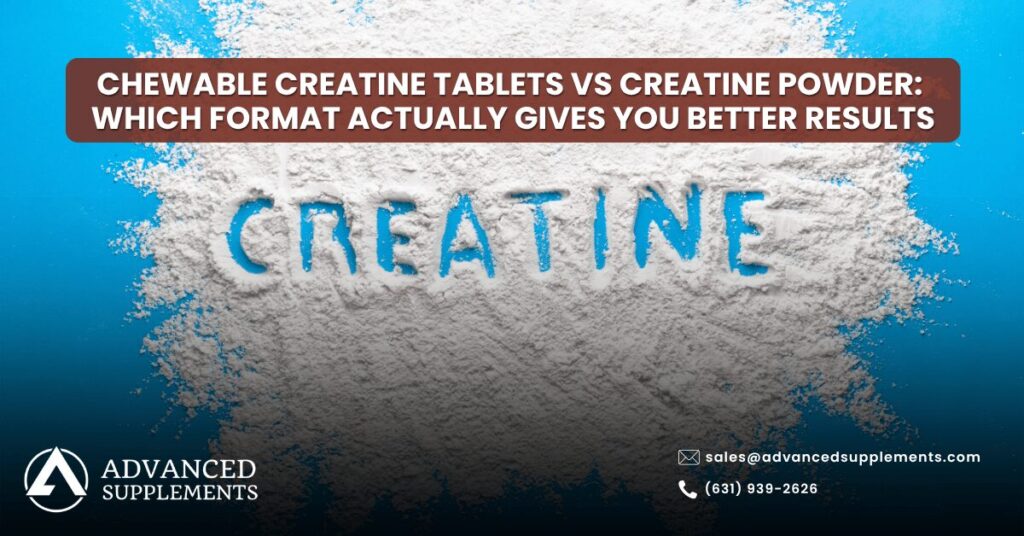
Chewable creatine tablets and creatine powder deliver the same active ingredient. Both build muscle strength and improve performance. The real difference is convenience, cost, and how well you stick to your daily dose. This guide breaks down everything you need to choose the right format for your goals.
What Creatine Actually Does Inside Your Body
Before anything else, let’s get the science right. Creatine monohydrate is a compound your body synthesizes in small amounts from the amino acids arginine, glycine, and methionine. About 95% of it ends up stored in skeletal muscle as phosphocreatine.
When you push hard, sprinting, squatting heavy, jumping, your muscles burn through ATP almost instantly. Phosphocreatine steps in and donates a phosphate group to regenerate ATP on the spot. That gives you a few more seconds of maximal output before fatigue takes over. Supplementing with creatine monohydrate saturates those phosphocreatine stores beyond their natural ceiling, which means more energy available per hard effort, better training volume, and better recovery between sets.
What does creatine do for men specifically? Research published in the Journal of Strength and Conditioning Research by Rawson and Volek, reviewing 22 controlled trials, found that men supplementing with creatine during resistance training improved maximal strength by an average of 8% over placebo groups, as documented in the Journal of Strength and Conditioning Research. A more recent 2024 meta-analysis confirmed that creatine monohydrate combined with resistance training significantly increased both upper and lower body strength in adults under 50, with an upper-body weighted mean difference of 4.43 kg compared to training with placebo, per findings published in Nutrients.
The International Society of Sports Nutrition position stand classifies creatine monohydrate as the most effective ergogenic nutritional supplement for increasing high-intensity exercise capacity and lean body mass during training, a conclusion drawn from hundreds of peer-reviewed trials.
Both chewable creatine tablets and creatine powder deliver this same molecule. Everything that follows is about how they get it there.
What Is Creatine Monohydrate Made From?
Understanding what is creatine monohydrate made from matters if you care about raw material quality, which any serious athlete or brand owner should.
Commercially, creatine monohydrate is synthesized from two compounds: sarcosine and cyanamide. They’re combined inside a sealed reactor under controlled pressure, temperature, and pH. The reaction forms creatine crystals suspended in solution. From there, centrifuges separate the crystals, multiple wash cycles strip out residual impurities, and then drying reduces the material down to a standardized moisture level. The result is a fine white powder milled to a consistent particle size.
This process is how creatine is made at every commercial creatine manufacturer level. A legitimate creatine manufacturer tests each incoming batch for heavy metals, microbials, and active ingredient concentration before it enters any production line. That’s a requirement under Good Manufacturing Practice standards, and it’s also just basic quality control.
Knowing how creatine is made also helps you understand why some creatine products are dramatically cheaper than others. Raw material purity and sourcing vary enormously between suppliers. When a creatine supplement manufacturer cuts corners on ingredient verification, that savings gets passed on in price but not in quality.
How Creatine Powder Is Manufactured
A powder supplement manufacturer starts with verified creatine monohydrate and builds the formula from there. Unflavored products may only add a flow agent like silicon dioxide to prevent clumping during filling. Flavored versions bring in citric acid, natural or artificial flavor compounds, and sweeteners.
The ingredients go into an industrial ribbon blender or paddle mixer until the batch reaches homogeneity. Blend uniformity testing happens before anything gets filled into canisters or pouches. A major challenge for any powder manufacturer working with creatine monohydrate is moisture. Creatine attracts water from ambient air, and without humidity controls throughout the production environment and on the packaging line, you get a product that arrives at the gym in a clumped brick instead of a flowable powder.
Creatine powder has held its ground for thirty years because it genuinely delivers. The cost per gram is lower than almost any other form. Manufacturing at volume is efficient. Dosing is flexible, which matters if you want to run a loading phase at 20 grams per day split across four servings. The powder supplement manufacturer landscape is also mature, meaning there are plenty of quality partners to work with.
The real-world downside is purely about friction. No shaker bottle, no creatine. No water nearby, no creatine. If your supplement routine is already built around a pre-workout shake, adding creatine powder costs nothing extra. But if it isn’t, the format introduces consistent low-level barriers that cause a lot of people to quietly fall off their dosing schedule.
How Chewable Creatine Tablets Are Made
Chewable creatine tablets use the same raw creatine monohydrate, but the route from ingredient to consumer is more complex. A tablet supplement manufacturer blends the active compound with binders, fillers, sweeteners, flavoring agents, and disintegrants before compression on a tablet press.
The trickiest part of tablet manufacturing for chewable formats isn’t the compression itself. It’s the hardness specification. The tablet needs to survive a production line, a truck, warehouse shelving, and whatever abuse a gym bag inflicts. At the same time, it needs to break apart comfortably when someone bites into it. It’s too hard, and it’s unpleasant. Too soft, and it crumbles in the bottle before anyone opens it.
That hardness window is narrow, and maintaining it across production batches requires a tablet manufacturing company with genuine experience in chewable dosage forms. A facility that only produces hard-pressed swallowable tablets will have trouble hitting that specification consistently. The formulation science around binder ratios, granulation method, and compression force for chewables is its own distinct discipline within supplement manufacturing.
There’s also the taste problem specific to chewable formats. Hard swallowable tablets pass the palate quickly. Chewables stay in contact with taste buds for several seconds of active chewing. Raw creatine monohydrate has a slightly bitter, mineral edge that needs masking. A well-formulated chewable creatine tablet handles this invisibly. A poorly formulated one reminds you of exactly why people used to just swallow creatine capsules without thinking about the taste.
Creatine Tablets vs Powder Absorption: What Research Says
Creatine tablets vs powder absorption is one of the most searched comparisons in this category. The research answer might not be what you expect.
Format matters much less than dose and consistency. Rawson and Volek’s meta-analysis in the Journal of Strength and Conditioning Research found that what drove strength gains across 22 studies was total daily creatine intake and duration of supplementation, not the vehicle it arrived in. Creatine monohydrate tablets vs powder produced equivalent muscle phosphocreatine saturation over time when subjects hit 3 to 5 grams per day consistently.
Where format creates a real difference is early onset. Creatine powder pre-dissolved in water arrives in the stomach already in solution. The small intestine can begin absorbing it almost immediately. Chewable creatine tablets start disintegrating in the mouth, which is faster than a hard capsule but slightly slower than pre-dissolved powder. Neither gap produces a meaningful difference in your results over weeks of consistent dosing.
The absorption question gets overweighted in these comparisons because people assume creatine works like caffeine, where you feel it working in real time. It doesn’t. The mechanism is cumulative saturation of muscle phosphocreatine stores, which happens over days and weeks, not minutes.
Chewable Creatine Tablets vs Creatine Powder: Side-by-Side Comparison
| Factor | Chewable Creatine Tablets | Creatine Powder |
| Effectiveness | Equal. Same creatine monohydrate, same muscle results | Equal. Proven across 30+ years of research |
| Convenience | No water, no shaker, no measuring needed | Requires scoop, liquid, and mixing time |
| Absorption Speed | Disintegration starts in the mouth | Already dissolved. Reaches gut slightly faster |
| Cost Per Serving | 15 to 30% higher due to tablet manufacturing complexity | Lower cost per gram across all price points |
| Dosing Flexibility | Fixed dose per tablet, less flexible for loading phases | Fully adjustable by scoop size |
| Daily Compliance | Higher. Easier to take anywhere, anytime | Lower for users without a mixing routine |
| Taste Experience | Flavored and enjoyable when well formulated | Unflavored versions are gritty. Flavored vary widely |
| Stackability | Standalone format, does not mix with other supplements | Stacks easily into any pre or post-workout drink |
| Best For | Travelers, beginners, on-the-go athletes | Experienced athletes, stack users, budget buyers |
Choosing the Right Supplement Manufacturing Partner
For brand owners, the format question is inseparable from the manufacturing relationship. A creatine powder line needs a powder supplement manufacturer with documented humidity controls, validated blend uniformity, and experience managing the moisture sensitivity of creatine monohydrate at scale.
A chewable creatine tablet line needs a tablet supplement manufacturer who has specifically formulated chewable dosage forms before, not just standard compressed tablets. Ask for disintegration specifications, hardness data from past batches, and flavor validation protocols. Those details separate manufacturers with genuine chewable experience from those who are guessing.
Advanced Supplements handles both formats from a 60,000 square-foot GMP-certified facility in Edgewood, New York. They hold UL NPA cGMP certification, have supported over 1,650 brands, and offer full-service capabilities across tablet manufacturing, powder manufacturing, and capsule manufacturing. For brands wanting to launch or expand a creatine supplement line, working with a single supplement contract manufacturer USA for multiple formats keeps quality standards consistent and simplifies the supplier relationship.
Frequently Asked Questions
-
Are chewable creatine tablets as effective as creatine powder?
Yes. Both deliver the same creatine monohydrate to your muscles. Daily dose and consistency drive results, not the format you choose.
-
How many chewable creatine tablets equal one powder serving?
Most chewable creatine tablets contain 1 to 2.5 grams each. You typically need two to five tablets to match the standard 3 to 5 gram daily dose.
-
Do chewable creatine tablets absorb faster than creatine powder?
Not meaningfully. Chewables break down faster than hard capsules, but pre-dissolved creatine powder reaches your gut in solution. Long-term results are equal.
-
Can you take chewable creatine tablets without water?
Yes. Chewable creatine tablets need no water, no shaker, and no mixing. Just chew and swallow, making them far more convenient than creatine powder on the go.
-
What does creatine do for men who lift weights?
Creatine monohydrate boosts phosphocreatine in muscle, fueling heavier lifts. Research confirms men gain 8% more strength on average versus training without it.
-
What is the difference between creatine monohydrate tablets and powder?
Creatine monohydrate tablets vs powder differ only in format. Tablets are portable and need no mixing. Powder costs less per gram. Both build muscle phosphocreatine stores equally.
-
Which creatine format is better for beginners?
Chewable creatine tablets suit beginners best. No equipment, no measuring, no routine needed. Simpler format means more consistent daily dosing and faster results.